The same words, said by people from different cultural backgrounds, can carry entirely different emotional loads. This isn't a soft observation — it's the reason that translation apps fail in ways that dictionary-based translation shouldn't, and it's the reason an AI trying to decode subtext needs to know where the speaker is coming from.
High-context vs. low-context communication
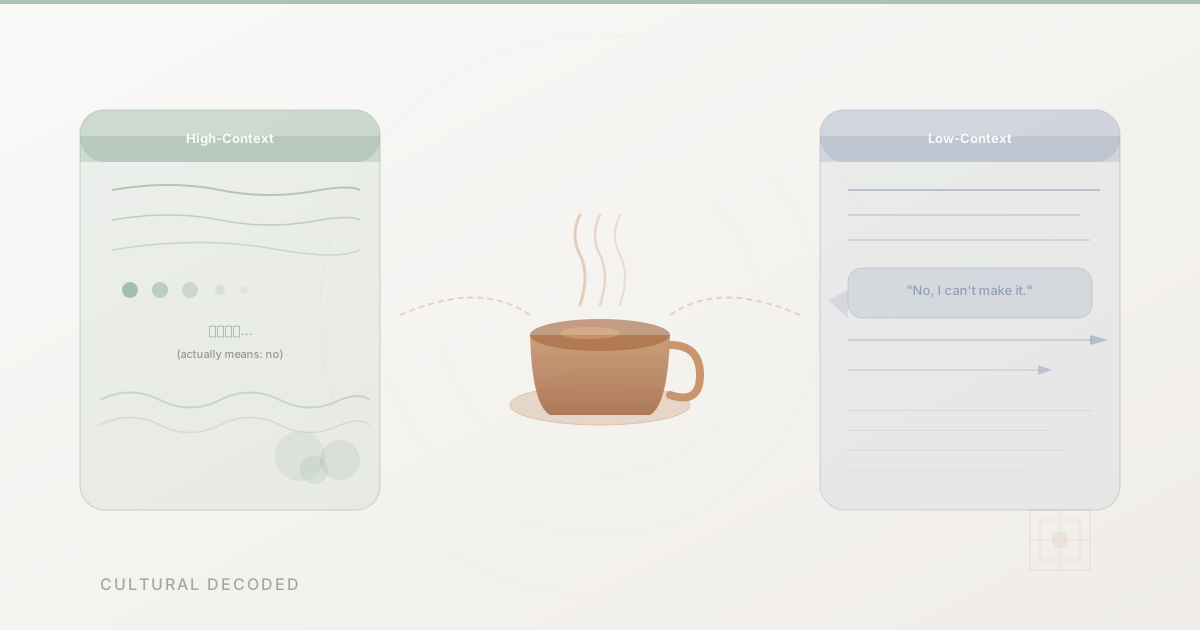
Researchers in cross-cultural communication often talk about "high-context" and "low-context" cultures. In low-context cultures (broadly: much of Northern Europe, the US, Australia), communication tends to be more explicit. What you mean is what you say. Ambiguity is something to minimize.
In high-context cultures (broadly: East Asia, much of the Middle East and Latin America), meaning is distributed across context, relationship history, and implication. What goes unsaid is often as important as what's said. Ambiguity isn't a bug — it preserves face and maintains harmony.
Neither approach is better. But they create problems when they meet.
The Chinese communication example
In Mandarin-speaking contexts, a direct "no" is often socially costly. It creates an awkward situation for both parties and breaks the surface of a conversation. So people don't usually say it.
Instead, you might hear:
- "That's a bit inconvenient" (不太方便) — which often means no
- "Let me think about it" (我再想想) — which may mean no
- "This might be difficult" (这个可能比较难) — which almost certainly means no
- Or simply a subject change
For someone from a low-context communication background, these aren't rejections — they're starting points for negotiation. The response is to push harder, propose alternatives, follow up. For the person who said them, the no was clear. They already said it. The follow-up feels aggressive.
This is a real, everyday source of misunderstanding between cultures, and it plays out in business meetings, personal relationships, and expatriate life constantly.
The directness problem in reverse
The same issue runs the other direction. A straightforward "this report has some problems, here's what needs to change" from a manager in a low-context culture reads, in many high-context cultures, as much harsher than intended. The absence of softening language, the lack of face-saving, the focus on problems rather than solutions — all of these register differently.
The speaker didn't intend to be harsh. But the listener, using their own interpretive frame, received something different.
Why this matters for AI subtext analysis
If you paste a message into an AI without telling it who wrote it and in what context, you're going to get a generic read. A message like "I'll think about whether I can make it" could mean many things. In one cultural context, it's a soft yes with some logistics to work out. In another, it's a polite no that the recipient is expected to understand and not push on.
This is why SubtextAI asks for context including the scene and, where relevant, the cultural register of the conversation. The words are one input. The cultural frame is another. Without both, the interpretation is incomplete.
Practical takeaways
If you're communicating across cultural contexts regularly:
- When in doubt, over-specify your intent rather than assuming the other person will read between the lines the same way you would
- Treat hesitations and softening language as potential negatives, not as starting positions for negotiation
- If you're in a high-context communication style and talking to someone who isn't, your "soft no" might need to be slightly more explicit than you're comfortable with
The goal isn't to flatten cultural differences — they're real and worth respecting. It's to know enough to communicate across them intentionally, rather than hoping good intentions will do the work that cultural literacy needs to do.